

After I originally wrote the article more than 2 years ago, titled “Smoke Dampers, Smoke Detectors And A Building Fire Alarm System – What Do We Have To Know & Why?” I received a few follow-up questions from the electrical consultants involved in design aspects related to the NBC (National Building Code) requirements for smoke detectors activating smoke dampers.
Eight such follow-up questions and eight answers are provided in this article.
The 2020 edition of the NBC, the 2019 edition of the CSA B44 “Safety Code for Elevators and Escalators “, and the 2019 edition of ULC S524 “Standard for installation of fire alarm systems “are used as the reference documents in conjunction with this article.
Question 1
What is the difference between a circulating air-handling system, a make-up air handling system, an exhaust system, a smoke control system, and a smoke venting system?
Answer to question 1: A typical circulating/recirculating air handling system serves more than one storey, more than one suite in a storey, or more than one fire compartment, and in which air may circulate between such storeys, suites, or fire compartments.
A make-up air handling system brings outdoor air into a building for the purpose of ventilation, and an exhaust air handling system transports air from a room or space in a building to the outdoors.
A smoke control (pressurization) system controls the migration of smoke from floor areas below the lowest exit storey into upper storeys in a high building, in conformance with the NBC requirements.
A smoke venting system provides venting to aid firefighting by venting each floor area to the outdoors through windows, wall panels, smoke shafts, or the building exhaust system in a high-rise building, in accordance with the NBC provisions.
Question 2
Is emergency power required by the NBC for the air handling systems?
Answer to question 2: Clauses 3.2.7.9.(1)(c), (d), and (e) of the NBC mandate an emergency power supply provided by an emergency generator in a high building:
- for a smoke control system performing in accordance with Article 3.2.6.2.
- for the smoke venting system, operating in conformance with Article 3.2.6.6.,
- for smoke control in a vestibule required by Sentence 3.2.8.4. (1) when an exit opens into an interconnected floor space (into an atrium), and
- for a mechanical exhaust system required by Article 3.2.8.7 – to remove air from an interconnected floor space (from atrium).
Clause 3.2.7.9.(1)(c) of the NBC also requires emergency power from an emergency generator to be provided with a mechanical air supply to areas of refuge in Care, Treatment or Detention Occupancies as follows:
“3.2.7.9. Emergency Power for Building Services
1) An emergency power supply capable of operating under a full load for not less than 2 h shall be provided by an emergency generator for…
c) fans and other electrical equipment that are installed to maintain the air quality specified in Articles 3.2.6.2. and 3.3.3.6.,
d) fans required for venting by Article 3.2.6.6 and
e) fans required by Clause 3.2.8.4.(1)(c) and Article 3.2.8.7. in buildings within the scope of Subsection 3.2.6.”
Question 3
Are smoke detectors used for automatic closure of smoke dampers in accordance with Sentence 3.1.8.11.(3) of the NBC, required to be connected to a building fire alarm system?
Answer to question 3: No, they are not required. Sentence 3.1.8.11.(3) of the NBC states as follows:
“3.1.8.11. Installation of Smoke Dampers
1) Where smoke dampers are used as a closure in an air-transfer opening, they shall be installed in the plane of the fire separation.
2) Where combination smoke/fire dampers are used as a closure in a duct, they shall be installed within 610 mm of the plane of the fire separation, provided there is no inlet or outlet opening between the fire separation and the damper.
3) Except as required by a smoke control system, smoke dampers and combination smoke/fire dampers shall be configured so as to close automatically upon a signal from an adjacent smoke detector located as described in CAN/ULC-S524, “Standard for Installation of Fire Alarm Systems,” within 1.5 m horizontally of the duct or air-transfer opening in the fire separation
a) on both sides of the air-transfer opening, or
b) in the duct downstream of the smoke damper or combination smoke/fire damper.”
Article 3.1.8.14 of the NBC applies to the operation of hold open devices permitted to be used on a closure in a required fire separation.
Relevant provisions of this NBC Article include:
“3.1.8.14. Hold-Open Devices
1) Except as provided in Sentences 3.1.8.10.(2) and 3.1.8.11.(3), a hold-open device is permitted to be used on a closure in a required fire separation, other than on an exit stair door in a building more than 3 storeys in building height and on a door for a vestibule required by Article 3.3.5.7., provided the device is designed to release the closure in conformance with this Article.
2) Except as provided in Sentences (5) and (6), where the building is provided with a fire alarm system, a hold-open device permitted by Sentence (1) shall release
a) in a single-stage system, upon any signal from the fire alarm system, and
b) in a 2-stage system,
i) upon any alert signal from the fire alarm system, or
ii) upon actuation of any adjacent smoke detectors.
3) Where the building is provided with a fire alarm system, a hold-open device permitted by Sentence (1) shall release upon a signal from a smoke detector connected to the fire alarm system and located as described in CAN/ULC-S524, “Standard for Installation of Fire Alarm Systems,” where the hold-open device is used on
a) an exit door,
b) a door opening into a public corridor,
c) an egress door referred to in Sentence 3.4.2.4.(2),
d) a closure serving an assembly, care, treatment, detention, or residential occupancy,
e) a door in a fire separation referred to in Clause 3.3.1.7.(1)(b) or Sentence 3.3.3.5.(4), or
f) a door required to function as part of a smoke control system.”
Sentence 3.1.8.14.(1) exempts smoke detectors that activate smoke dampers in accordance with Sentence 3.2.8.11.(3) of the NBC for connection to a building fire alarm system. These smoke detectors are intended solely to activate smoke dampers that operate as required by Sentence 3.1.8.11.(3) of the NBC, without being connected to a building fire alarm system. Only smoke detectors required by Subsection 3.2.4. or Article 3.1.8.14. of the NBC, along with those mandated by Clause 2.27.3.2.2 of the CSA B44 “Safety Code for Elevators and Escalators,” must be connected to a building fire alarm system as automatic fire alarm initiating devices of the fire alarm system.
Note: Clause 2.27.3.2.2 of B44 states the following:
“2.27.3.2.2 In jurisdictions enforcing the NBCC, smoke detectors, or heat detectors in environments not suitable for smoke detectors (fire alarm initiating devices), used to initiate Phase I Emergency Recall Operation shall be installed in conformance with the requirements of the NBCC and shall be located
(a) at each elevator lobby served by the elevator
(b) in the associated elevator machine room, a machinery space containing a motor controller or
driving machine, a control space, or a control room
(c) in the elevator hoistway, when sprinklers are located in those hoistways
NOTES:
(1) 2.27.3.2.2: Smoke and heat detectors (fire alarm initiating devices) are referred to as “fire detectors” in the NBCC. Pull stations are not deemed to be fire detectors.
(2) 2.27.3.2.2(b): A machinery space containing a motor controller or driving machine located in the elevator hoistway or a control space located in the elevator hoistway requires a fire alarm initiating device regardless of the presence of sprinklers.”
Question 4
What are ULC S524 requirements for the installation of smoke detectors, which activate smoke dampers mandated by Sentence 3.1.8.11.(3) of the NBC?
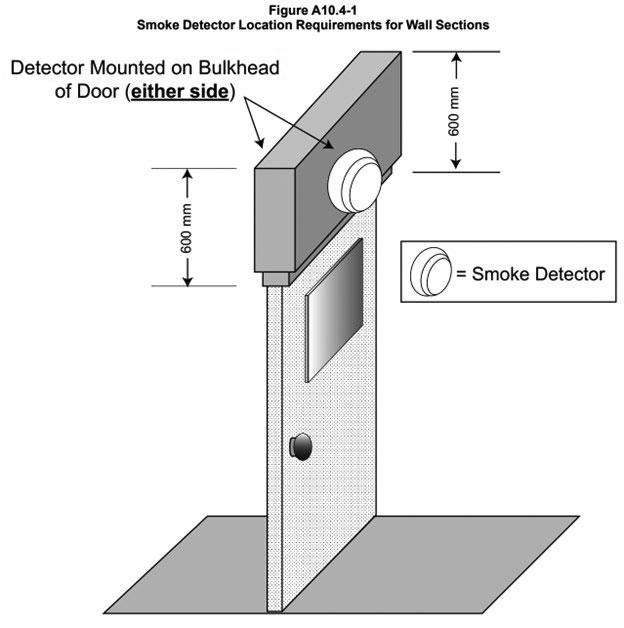
Answer to question 4: If a smoke damper is installed in a wall of a room which is served by the air distribution system, the smoke damper must be configured to close automatically upon a signal from an adjacent spot-type smoke detector located as described in CAN/ULC-S524, “Standard for Installation of Fire Alarm Systems,” within 1.5 m horizontally” of air-transfer opening in the fire separation (in the wall of that room) on each side of the air-transfer opening.
ULC S524 depicts locations of such smoke detectors when these smoke detectors activate hold-open devices on doors in conformance with Article 3.1.8.14 of the NBC. (See Figure 1).
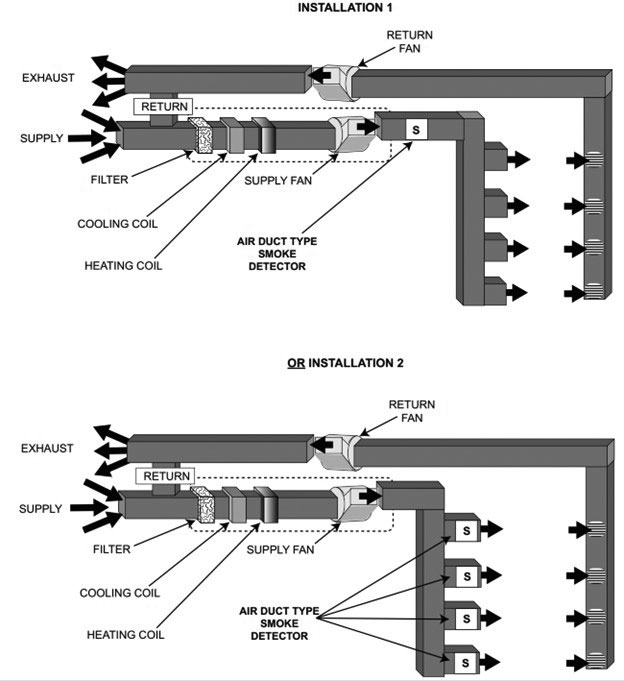
If, however, a smoke damper is installed in a duct of an air distribution system, a duct-type smoke detector must be located in the duct downstream of the smoke damper or combination smoke/fire damper, in accordance with ULC S524. (See Figure 2).
Question 5
What is a closure, referenced by Articles 3.1.8.11. and 3.1.8.14. of the NBC?
Answer to question 5: Closure is a defined term in the NBC, and it means the following: “Closure means a device or assembly for closing an opening through a fire separation or an exterior wall, such as a door, a shutter, a damper, wired glass or glass block, and includes all components such as hardware, closing devices, frames and anchors.”
It is clear from this definition that a smoke damper is a closure that is installed in a duct of an air distribution system and that is normally held open but designed to close automatically in the event of a fire to maintain the integrity of the fire separation.
In a smoke control system, such dampers do not necessarily function as closures, as they operate in accordance with the intended design of an individual smoke control system, and mechanical consultants select the appropriate status of smoke dampers’ positions for operation of a smoke control system in each installation.
Question 6
Are duct type smoke detectors considered to be “fire alarm initiating devices?”
Answer to question 6: When a duct type smoke detector is required by Article 3.2.4.12. of the NBC (see answer to question 3), such duct type smoke detector must be connected to a fire alarm system, and operation of the duct type smoke detector must initiate the following actions:
- transmit a fire alarm signal in a single-stage fire alarm system, or an alert signal in a 2-stage fire alarm system,
- provide a separate zone indication on a fire alarm annunciator, as required by Sentence 3.2.4.8.(2)(d) of the NBC,
- shut down air moving fan of the air handling system, and
- to close the smoke damper, if a smoke damper is provided in the air handling system.
Article 3.2.4.12. of the NBC states the following:
“3.2.4.12. Prevention of Smoke Circulation
1) If a fire alarm system is installed, an air-handling system shall be designed to prevent the circulation of smoke upon a signal from a duct-type smoke detector if the air-handling system
a) serves more than one storey,
b) serves more than one suite in a storey, or
c) serves more than one fire compartment required by Sentence 3.3.3.5.(2).”
Question 7
Is protection against exposure to fire required by the NBC for conductors supplying all air handling systems?
Answer to question 7: No. Protection against exposure to fire is only mandated by the NBC for conductors that supply air handling systems that must be provided with an alternate power supply source from an emergency generator, as indicated in the answer to question 2 above. Sentence 3.2.7.10.(5) of the NBC clarifies that conductors between the normal power supply source and the air handling systems connected to the normal power supply source, are not required to be provided with protection against exposure to fire, and that only conductors between an emergency generator and the electrical equipment served by the generator, mut be protected against exposure to fire (see below):
“5) Except as stated in Sentences (7) and (9), the electrical conductors referred to in Sentence (1) are those that extend from the source of emergency power to
a) the equipment served, or
b) the distribution equipment supplying power to the equipment served, if both are in the same room (see Note A-3.2.7.10.(5)(b)).”
It is interesting to note the inconsistency between the requirements of Article 3.2.7.9. of the NBC – to provide the emergency generator for certain air handling systems and the requirement of Article 3.2.7.10. of the NBC – to protect conductors supplying air moving systems against exposure to fire. While Article 3.2.7.9. does not list mechanical systems serving contained use areas identified in Clauses 3.3.3.7.(4)(a) and (b), (see answer to question 2 above), Clause 3.2.7.10.(1)(c)(ii) of the NBC states that the protection of conductors for the mechanical systems, serving contained use areas, is, indeed, required. (see below):
“3.2.7.10. Protection of Electrical Conductors
1) The protection of electrical and emergency conductors referred to in Clauses (a) to (c) shall conform to the requirements stated in Sentences (2) to (11):
a) electrical conductors located within buildings identified in Article 3.2.6.1. serving
i) fire alarms,
ii) emergency lighting, or
iii) emergency equipment within the scope of Articles 3.2.6.2.
to 3.2.6.8.,
b) emergency conductors serving fire pumps required to be installed under Article 3.2.5.18., and
c) electrical conductors serving mechanical systems serving
i) areas of refuge identified in Clause 3.3.3.6.(1)(b), or
ii) contained use areas identified in Clauses 3.3.3.7.(4)(a) and (b).”
Local AHJs enforcing the NBC should be consulted regarding such an inconsistency for each respective design and installation project.
Question 8
Is electrical supervision of smoke dampers or air handling systems required by a building fire alarm system?
Answer to question 8: No, it is not required. Sentence 3.2.4.9.(1) of the NBC mandates electrical supervision for a fire alarm system, as follows:
“3.2.4.9. Electrical Supervision
1) Electrical supervision shall be provided for a fire alarm system.“
Clause 6 of ULC S524 elaborates on the electrical supervision requirements as follows:
“6 Electrical Supervision
6.1 General
6.1.1 Electrical supervision of the circuit / pathway shall be provided for the following:
a) Manual stations;
b) Fire detectors;
c) Water flow devices;
d) National Building Code of Canada required supervisory devices for water based fire protection systems;
e) Audible signal devices;
f) Visible signal devices;
g) Voice communication equipment;
h) Emergency telephone handsets
i) Main power supplies and emergency power supplies
j) Power supplied to field devices;
k) Annunciators;
l) Display and control centres;
m) Common fault indication from the engine-driven generator, as required by Clause 5.5; and
n) Common fault indication from the UPS, as required by 5.5.2.”
This ULC S524 requirement clarifies that only equipment comprising a fire alarm system is subject to electrical supervision.
The NBC recognizes some air handling systems (smoke control and smoke venting systems in a high building) as “auxiliary equipment” in accordance with Clause 3.2.6.7.(2)(j):
“2) The central alarm and control facility required by Sentence (1) shall include
a)
b)
i) means, as appropriate to the measure for fire safety provided in the building, to
i) actuate auxiliary equipment identified in Articles 3.2.6.2., 3.2.6.3. and 3.2.6.6., or
ii) communicate with a continually staffed auxiliary equipment control centre.”
iii)
“Auxiliary equipment” referenced in this Clause means equipment comprising a smoke control or smoke venting system. Although the NBC does not offer a definition of “auxiliary equipment”, ULC S524 defines this equipment as “ancillary device.” It clarifies that such equipment is not part of a fire alarm system (see below):
“ANCILLARY DEVICE – A device which has a life-safety application, is connected to the fire alarm system, but is not part of the fire alarm system.
NOTE: Examples of items which may be connected, include elevators, smoke control and venting systems and fire doors.”
Therefore, equipment comprising a typical smoke control or smoke venting system including fans and smoke dampers in a high building (i.e. equipment which functions as “auxiliary equipment/ancillary device” in conjunction with a fire alarm system), is not subjected to the electrical supervision. Still, its operation is subjected to testing in conformance with Article 3.2.6.9. of the NBC:
“3.2.6.9. Testing
1) The systems for control of smoke movement and mechanical venting required by Articles 3.2.6.2. and 3.2.6.6. shall be tested to ensure satisfactory operation. (See Note A-3.2.6.9. (1).)”
Hopefully, answers to questions posted in this article clarify the subject of handling systems, smoke dampers, and smoke detectors application in electrical design and installations.
And as usual, appropriate local AHJs should be consulted for specific issues related to electrical design and installations of handling systems, smoke dampers, and smoke detectors.