
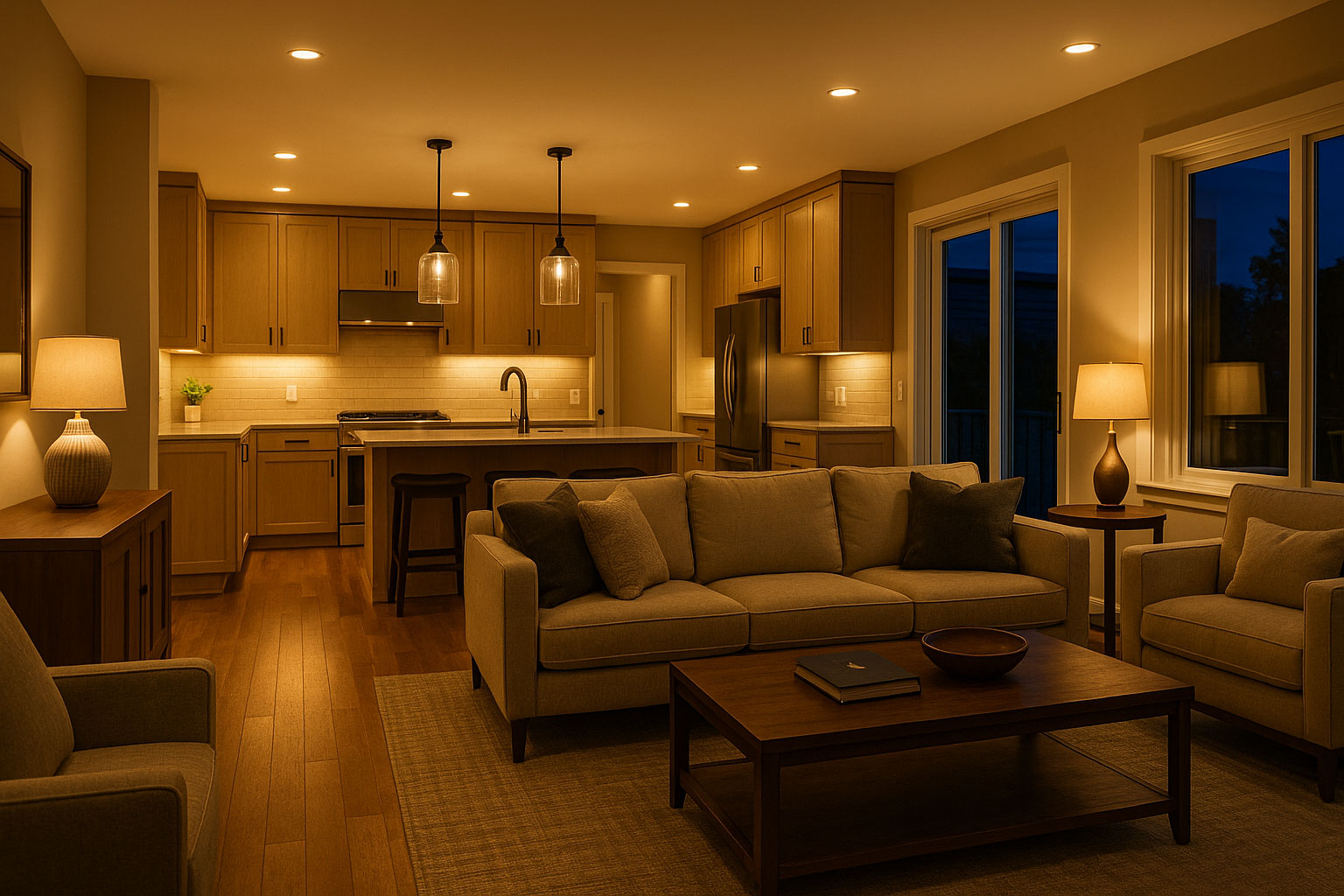

Residential lighting requirements aren’t centralized in one place of the National Electrical Code® (NEC®); they’re woven through core articles that define terms, equipment suitability, outlet locations and controls, load calculations, and special wet-location or near-water rules. This feature stitches those threads together so designers, installers, and inspectors can quickly find the right section, understand the baseline requirements, and keep up with recent and upcoming changes that directly affect lighting design and compliance. Let’s start with Article 100, Definitions, and use its exact vocabulary on drawings and submittals to avoid plan review ping-pong.
Article 100 — Definitions that drive residential compliance
Terms such as “luminaire,” “lighting outlet,” “location, damp,” and “location, wet” determine how you select and mark products later in Article 410, Luminaires, Lampholders, and Lamps, and Article 110, General Requirements for Electrical Installations. The 2023 NEC also added the emergency-lighting lexicon (e.g., Emergency Luminaire, Directly Controlled, and ELCD) used with Article 700/UL 924 equipment (Art. 100).
NFPA 70E®, Standard for Electrical Safety in the Workplace, is a best practice to provide a practical safe working area for employees and to help reduce electrical hazards and workplace injuries. Electrical hazards can include electric shock, arc flash, and arc blast.
- “Luminaire” / “Lighting outlet.” The Code’s basic building blocks for lighting layout, control, and load calculations. These terms drive where branch-circuit controls are required [210.70, Lighting Outlets Required], how you classify outlets, and how you count VA. [Use Article 100 for the terms, then apply 210/220/410 accordingly.]
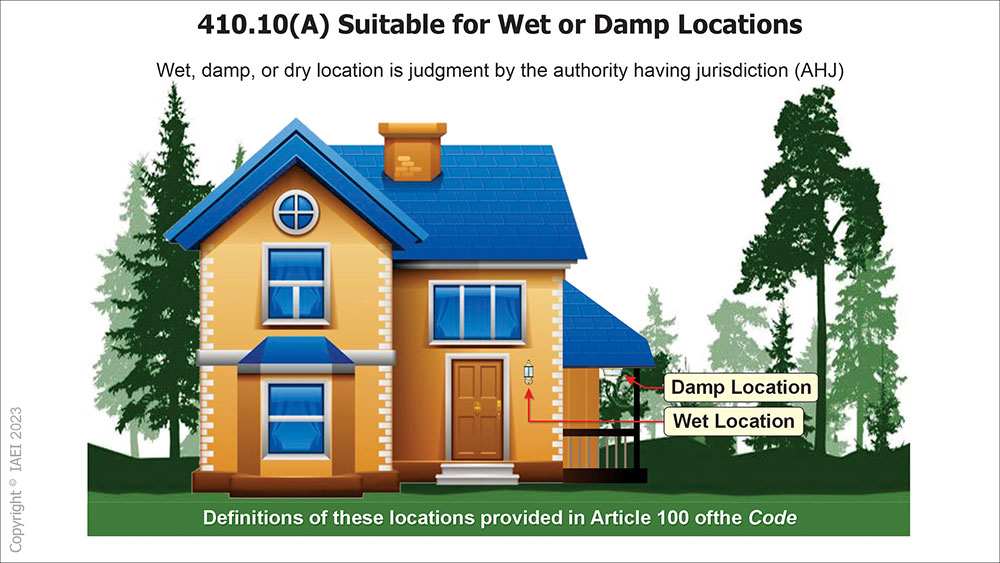
- “Location, Damp / Wet.” These definitions determine whether a luminaire must be “damp-location” or “wet-location” rated—e.g., under canopies, roofed porches (damp), or fully weather-exposed/washdown areas (wet). Getting the location wrong is the #1 reason luminaires fail inspection in exterior and food-service spaces. Choose fixtures correctly for porches, baths, laundry areas, and exterior soffits.
- Emergency-lighting terms (ELCD, directly controlled luminaires). Useful where owners add unit equipment or generator-backed egress lighting. The 2023 NEC clarified the vocabulary used with Article 700 and UL 924 devices—e.g., Emergency Luminaire, Directly Controlled (a normal/emergency luminaire that’s “forced on” to emergency levels by a listed control input) and ELCD/ALCR/BCELTS devices that legally bypass or control functions during a loss of normal power. These definitions resolve longstanding ambiguity about how “normal” luminaires can serve egress when paired with listed control devices.
- Special-Purpose GFCI (SPGFCI). Matters around higher-voltage water features and some specialty spaces. Added in 2023 to address situations where standard Class A GFCI is insufficient—particularly for higher-voltage horticultural lighting and specific pool or water-feature circuits that exceed 150 V to ground. If your specifications specify “GFCI” generally for these systems, Article 100’s SPGFCI definition (and the related article text) explains what is actually necessary.
2023 definition housekeeping that affects lighting work
- All definitions moved to Article 100. If you used to cite a definition from “410.2” or similar, update your notes—everything lives in Article 100 now, with article tags in parentheses for terms unique to a single article.
- Emergency-lighting terms standardized. Article 100 additions align with UL 924 practice and Article 700’s control topologies—critical if you’re using networked/PoE/0-10 V/DMX controls to realize emergency levels.
Field takeaway: Include the exact Article 100 term on your drawings (e.g., “ELCD, UL 924 listed,” “luminaire listed for wet location”). It prevents substitution games and speeds up approvals.
Article 110 — The “how it passes inspection”
Article 110, General Requirements for Electrical Installations, doesn’t “do lighting,” but it regulates how all lighting equipment is selected, installed, connected, marked, protected, and maintained. If a lighting system fails, it’s often due to Article 110. Compliance at installation lives in Article 110. Listed luminaires, retrofit kits, drivers, and fan–light kits must be installed per their listing and instructions [110.3(B), Listing, Installation and Use]. Pick gear that can survive the space—damp/wet/corrosive conditions are addressed in 110.11—and torque all terminations to the value on the device or label [110.14(D), Terminal Connection Torque]. In service rooms and similar spaces, provide lighting for the required working space and place the control at the usual point of entry so personnel don’t reach across equipment [110.26, Spaces About Electrical Equipment].
2023 highlights you’ll actually notice
- Article 100: All definitions centralized; new/updated emergency-lighting terms align with UL 924 and Article 700 control strategies.
- Article 110: Clearer language on workspace egress and illumination in 110.26(D); continued emphasis on torquing terminations in 110.14(D) and on durable field labels in 110.21(B).
Article 210 — Where lights are required and how they’re controlled
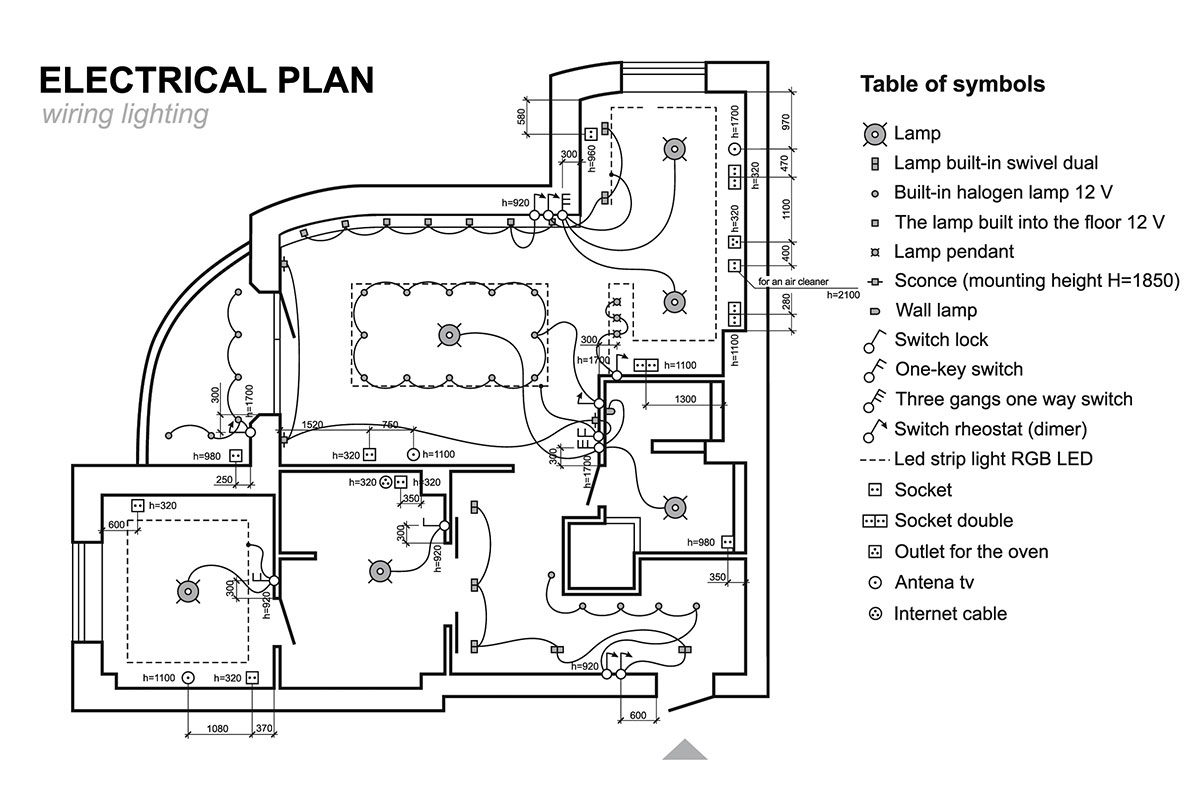
Where lights are required and how they’re controlled is set primarily by 210.70, Lighting Outlets Required. Provide at least one lighting outlet controlled by a listed wall-mounted control in every required space—habitable rooms, kitchens, bathrooms, halls, garages/accessory structures, and similar areas; stairways need control at each floor or landing with an entry to the stair; spaces used for storage or equipment service (attics, underfloor areas, basements, utility rooms) need a lighting outlet with the control at the entry and the luminaire located near the serviceable equipment [210.70(A)(1)–(3)].
Two 2023 clarifications matter in dwellings: a battery-only wall control cannot be the sole means of control unless the lighting automatically energizes upon battery failure, and laundry areas are explicitly included among spaces requiring a controlled lighting outlet [210.70]. Remember that dwelling lighting outlets (like receptacle outlets) on many branch circuits require AFCI protection in the rooms listed in 210.12(A), Means of Protection. If a bathroom luminaire includes an integral receptacle, that receptacle must be GFCI-protected per 210.8(A), Dwelling Units.
Per 210.70, provide a controlled lighting outlet in every required space (habitable rooms, kitchen, bathrooms, laundry areas (2023 update), halls, garages, etc.). Battery-only wall controls cannot be the sole means unless the lighting auto-energizes on battery failure (2023 update). Include stairway controls, basement/attic/underfloor/utility spaces used for storage or equipment service, and grade-level exterior doors.
Also, a receptacle that falls under Section 210.62, Show Windows, is technically commercial, but note it if a live-work or mixed-use dwelling has a display frontage. While it’s not a lighting outlet rule per se, it aligns with the show-window lighting load allowances in Article 220 and helps ensure lighting and receptacle coordination do not fall between trades. Inspectors regularly check the placement of the receptacle and the feeder or service allowance in the load calculation.
Article 220 — Sizing the service for residential lighting
Residential load calculations are straightforward in Article 220, Branch-Circuit, Feeder, and Service Load Calculations. The minimum unit load for a dwelling is 3 VA/ft² for general lighting and general-use receptacles [220.41, Dwelling Units, Minimum Unit Load], and you add the small-appliance and laundry loads separately [220.52(A), Small-Appliance Circuit Load, and 220.52(B), Laundry Circuit Load] [the 3 VA/ft² is the baseline most plan reviewers check first]. However, the base 3 VA/ft² accounts for the typical lighting and receptacle combination in dwelling spaces. This is the value most plan reviewers check first on residential services.
Finally, remember continuous-load treatment. When sizing feeders and services, treat lighting that’s expected to operate 3 hours or more as continuous and size conductors at not less than 125% of that continuous load plus 100% of any noncontinuous load—apply at the feeder and service per 215.2(A)(1), Continuous and Noncontinuous Loads, and 230.42(A)(1) before any adjustment/correction factors.
Articles 404 & 406 — Controls now and in 2026
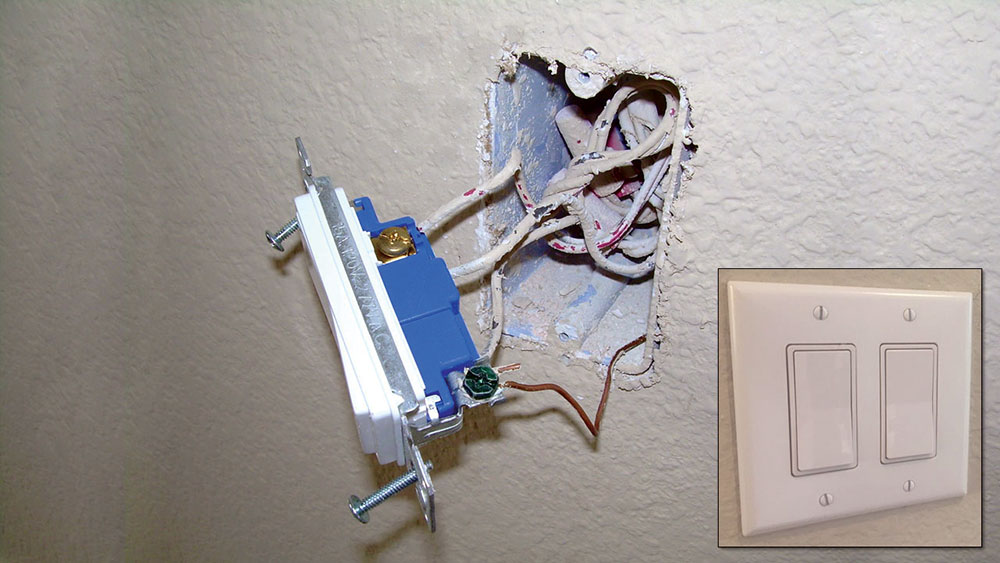
Article 404, Switches, establishes the standards for switch construction, ratings, terminations, grounding, and installation. In lighting work, two aspects are most important: (1) where a neutral is needed at the switch for modern controls, and (2) how snap switches and electronic controls must be terminated and listed. [Note: these requirements will be moving to Article 406 Part III, General-Use Snap Switches, Dimmers, and Electronic Control Switches, in the 2026 NEC). Modern sensors and smart controls often need a neutral; Section 404.2(C), Switches Controlling Lighting Loads, requires a grounded (neutral) conductor at many switch locations, with limited exceptions. Terminations and device markings matter: New Section 404.14(D), Snap Switch Terminations, explains that push-in (screwless) terminals on snap switches are limited to 14 AWG copper conductors on 15-ampere circuits unless the device is specifically listed and marked otherwise. It also links conductor compatibility to CO/ALR markings when aluminum or copper-clad aluminum is used. In short: verify the device markings before connecting anything other than 14-AWG copper on stab-ins, and check for CO/ALR markings if aluminum conductors are involved.

Section 404.16, Reconditioned Equipment (new in 2023), explicitly states that lighting, dimmer, and electronic control switches—and snap switches of any kind—are not allowed to be reconditioned. If a device is damaged by fire, water, or smoke, it must be replaced; cleaning and returning it to service are not permitted. This language clarifies a common gray area and provides inspectors with clear guidance.
Looking ahead to 2026
A major organizational change moves device-type switches (such as wall switches, dimmers, and electronic control switches) from Article 404 to Article 406. Article 404 will continue to cover larger general-use switches, pullouts, fused disconnects, and circuit breakers used as switches. For plan reviewers and spec writers, expect section renumbering in your standard details; the technical requirements for device-type switches will largely remain the same in the new 406 Part III.
Article 406 — Wiring Devices (receptacles—and soon, your wall switches)
Historically, Article 406 focused on receptacles, cord connectors, and attachment plugs. For lighting crews, it was mostly relevant at the edges (e.g., receptacle-controlled lighting zones or signage/outline lighting outlets). Two developments have increased 406’s importance for lighting practices. First, the 2023 edition combined reconditioning rules for 406-covered devices into Section 406.2, Reconditioned Equipment, making it easier to find all the requirements—what can and can’t be reconditioned—for receptacles and related wiring devices in one place (similar to the approach added in Article 404 for switches). This change improves usability and prevents missing a prohibition that might have been hidden elsewhere.
Second—and more significant—the 2026 NEC moves general-use snap switches, dimmers, and electronic control switches into Article 406 as a new Part III (“Wiring Devices”), alongside receptacles. The reason is straightforward: device-type switches function like other wiring devices in installation and listing, so grouping them enhances consistency. Practically, this means your typical wall switch/dimmer details, aluminum-conductor compatibility notes, and push-in terminal limitations will be referenced from 406.30-40 rather than 404.x once your jurisdiction adopts 2026. Start pre-labeling your drawings and specifications now to prevent mis-citations during plan review.
Article 410 — Where you can (and can’t) put luminaires
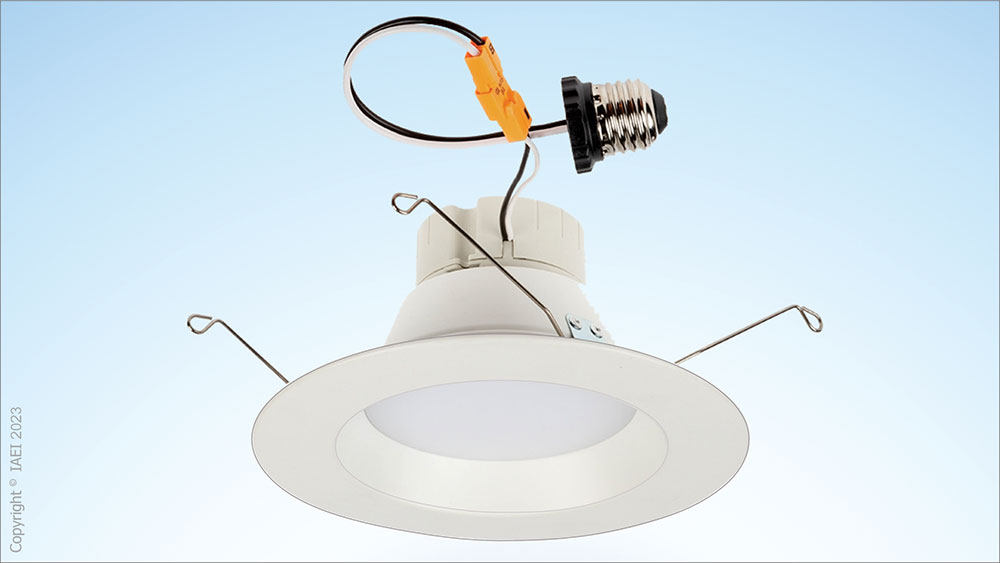
Selecting and placing the actual luminaires is Article 410, Luminaires, Lampholders, and Lamps. Use equipment that is listed/identified and supported by boxes or fittings rated for the load; ceiling fan–light combinations require a box listed for paddle-fan support [410.36, 314.27(C)]. Keep splices in accessible enclosures/compartments (300.15). If you convert cans or wraps to LED, the retrofit kit must be listed and installed exactly per instructions so the assembly remains compliant [410.6, 110.3(B)]; a luminaire properly retrofitted with a listed kit is not considered reconditioned under 410.2.
Bathtub/shower areas. Location-specific rules are strict: in bathtub/shower areas, no cord-connected, chain, pendant, or track luminaires—and if a ceiling fan includes a light kit, it’s treated as a luminaire for the zone; any luminaire within the outside dimensions up to 8 ft must be marked for damp (or wet if subject to spray) and meet the 3-ft horizontal/8-ft vertical separation limits. The 2023 NEC clarified that the bathtub/shower zone rules in Section 410.10(D)(1), Bathtub and Shower Areas, apply when a ceiling-suspended (paddle) fan includes a light kit—i.e., if there’s a luminaire on the fan, the luminaire rules apply. The revision prevents the argument that a “fan-only” unit could be installed in the restricted zone and later have a light kit added; if it’s shipped or installed with a light kit, the luminaire rules and location/listing limitations apply.
For all exterior and laundry/bath areas, match the marking to the environment—“suitable for wet location” where exposed, and “damp location” where covered but subject to moisture—and install to prevent water entry [410.10(A), (B)].
Closets. Clothes-closet spaces remain a common failure point. Section 410.16, Luminaires in Clothes Closets, defines the closet storage space boundaries and limits luminaires by type and clearance from that storage volume; surface-mounted fluorescent/LED luminaires listed as suitable for installation within the closet storage space can be used where labeled, while open lamps and pendants in the storage volume remain prohibited. Inspectors routinely check the product labeling and the measured clearances—don’t rely on “low-heat LED” assumptions without the specific closet suitability listing.
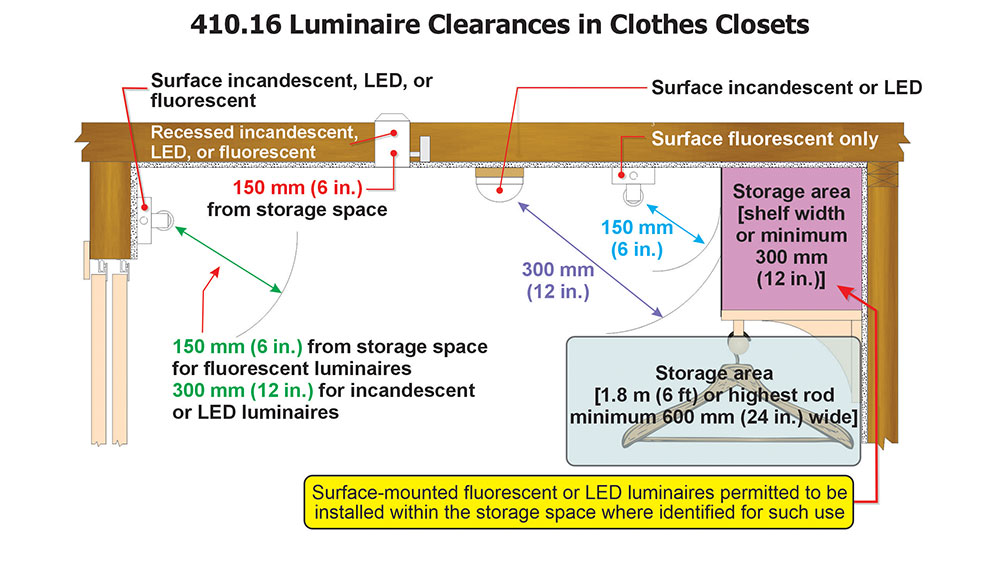
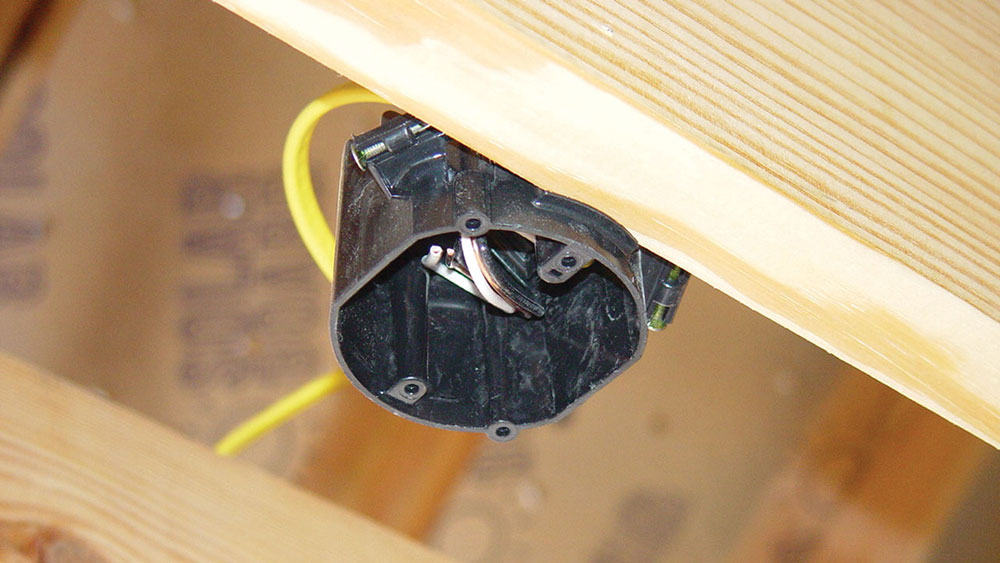
Support and connection. Support and connection. Article 410’s mounting and connection rules—use boxes or fittings identified for the luminaire load [314.27(A)(1)–(2); 410.36(B)/(E), Means of Support], mount ceiling fan–light combinations on boxes listed for paddle-fan support [314.27(C), Boxes at Ceiling-Suspended (Paddle) Fan Outlets], and keep splices in accessible enclosures/wiring compartments [300.15, Boxes, Conduit Bodies, or Fittings-Where Required]—are generally unchanged but easy to miss during swaps and retrofits. When retrofit kits convert existing housings to LED, the kit must be listed [410.6, Listing Required] and installed per its listing/instructions [110.3(B), Installation and Use]; the 2023 Code also clarifies that a luminaire retrofitted in accordance with the kit instructions is not “reconditioned” under 410.2, Reconditioned Equipment. (This is a common punch-list item in modernization projects.)
Depth and distance details still matter. For wet or damp locations, Article 410 links the product’s marking to the environment—luminaires in wet locations must be marked “Suitable for Wet Locations,” and those in damp locations must be marked for damp (or wet); installation must prevent water from entering wiring compartments [410.10(A), (B), Luminaires in Specific Locations]. It also requires physical separation from tubs/showers and closet storage areas: in bathtub/shower zones, no parts of cord/chain/pendant/track luminaires—or ceiling fans with light kits—are permitted within 3 ft horizontally and 8 ft vertically from the tub rim or shower threshold, and luminaires within the outside dimensions up to 8 ft must be marked for damp (or wet where subject to spray) [410.10(D)(1)–(2), Bathtub and Shower Areas].
In clothes closets, only use permitted luminaire types and maintain the minimum clearances from the defined closet storage space as specified in 410.16, Luminaires in Clothes Closets (including the 2023 renumbering to 410.16(D), Location, for the clearance table). Field teams should measure from the defined enclosure—that is, the entire 3-ft/8-ft tub/shower zone and the closet storage space volume—and not just the trim ring [410.10(D)(1); 410.16(A), (D)]; they should also verify the marking on the installed luminaire itself (not just the submittal), installing it according to its listing/labeling [110.3(B)].
Near water
Near water, two articles dominate. Article 680, Swimming Pools, Fountains, and Similar Installations, governs pools, spas, and fountains: place luminaires, lighting outlets, and ceiling-suspended (paddle) fans according to the strict height/clearance and protection rules in 680.22(B), Luminaires, Lighting Outlets, and Ceiling-Suspended (Paddle) Fans; receptacles within 20 ft of the water require GFCI up to 250 V (and SPGFCI where specified) per 680.22(A)(4), GFCI and SPGFCI Protection. Underwater luminaires must be installed 4–18 inches below the normal water level and be removable to the deck for servicing (with sufficient cord length), connected through listed forming shells and junction boxes/enclosures, and bonded per 680.23(A)(5), 680.23(B)(1)–(3), (5), (6) and 680.24; provide equipotential bonding per 680.26, Equipotential Bonding. These rules work together to keep people and electricity separated by distance, isolation, and quick protection.
Article 682, Natural and Artificially Made Bodies of Water, applies to wiring/equipment at natural or artificial bodies of water not covered by 680 (e.g., stormwater basins, fish ponds, irrigation channels). The electrical datum plane (EDP) sets the vertical limit for equipment: keep enclosures and connections above the EDP unless specifically listed for submersion (682.10, 682.12) and locate the required GFCI (or other ground-fault device) not less than 12 inches above the EDP (682.15, Ground-Fault Protection). These requirements are in addition to 210.8, Ground-Fault Circuit-Interrupter Protection for Personnel.
Low-Voltage Lighting
Low-voltage (≤30 V) landscape and accent lighting falls under Article 411, Low-Voltage Lighting, which applies to lighting systems operating at 30 volts or less supplied from a listed low-voltage lighting power unit or a Class 2 source (scope/definitions, Art. 411). Each system must be listed—both the power supply and the luminaires/fittings—and installed in accordance with its listing and instructions [411.3, Voltage Limitations, and 110.3(B), Installation and Use]. On the line (primary) side, treat the wiring like any other branch circuit (Chapter 1–4 methods, overcurrent, boxes, grounding/bonding) [411.4, Low-Voltage Lighting Systems].
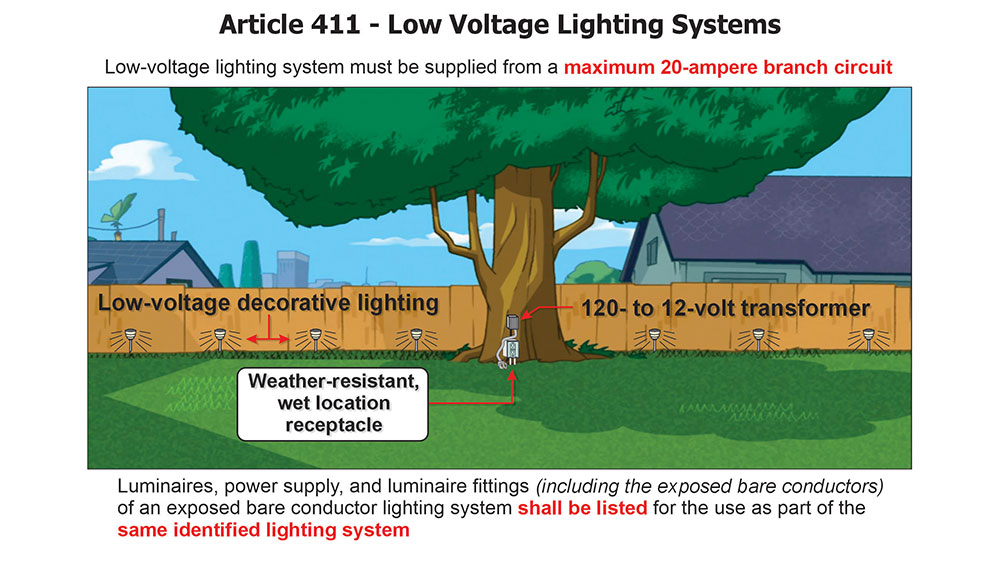
On the secondary (≤30 V) side, use only the wiring methods permitted for low-voltage lighting systems—for example, listed low-voltage landscape cable that’s suitable for direct burial where used outdoors, with fittings/connectors listed for the cable and location; do not fish generic LV cable in walls/ceilings unless it’s part of a listed assembly approved for that use [411.7, Secondary Circuits]. Where the low-voltage cable is buried, provide minimum cover per Table 300.5(A) (low-voltage landscape lighting cable is typically 6 inch cover—check the table/notes for exact conditions) and add physical protection where subject to damage [300.5, 300.5(D)]. All splices and terminations must use listed connectors and be made in listed enclosures when required by the product instructions and the environment [110.14, 300.15, 314.15 for wet-location boxes].
Power units (transformers/LED power supplies) installed outdoors must be identified for wet locations and mounted to shed water; if cord-and-plug connected, the receptacle must be GFCI-protected and weather-resistant with an in-use (while-in-use) cover [210.8(A)(3), 406.9(B)(1), 406.4(D)(6)]. Keep Class 2 conductors and enclosures separate from Class 1 power/lighting conductors unless the wiring method and equipment are listed for mixing (general separation rules via 300.3(C) and power-limited circuit rules in 725.136; Article 411 points you back to these where applicable). Where low-voltage luminaires are installed near pools, spas, or fountains, remember that Article 680 still governs clearances and protection—luminaires/fans in the 0–10 ft zones must meet 680.22(B), and nearby receptacles require GFCI up to 250 V [680.22(A)(4)]; low voltage does not waive the location or GFCI rules. Finally, for fan–light combinations or any heavy decorative low-voltage luminaires hung from a box, verify the outlet box is identified for the purpose and rated for the weight/motion [314.27(A), (C)]. Design tip: because LV runs are long and currents are higher at 12/24 V, manage voltage drop with heavier-gauge secondary cable, shorter runs, or multiple power units—while still staying within the listed system constraints of 411.3/110.3(B).

2023 Highlights (Residential)
- Battery-only controls limited (210.70).
- Laundry areas explicitly added (210.70).
- Bathtub/shower rule clarified for fan + light kits [410.10(D)].
- All definitions centralized; emergency-lighting terms added (Article 100).
2026 Outlook (Residential)
- Device-type switches/dimmers relocate to 406 Part III (update all cites).
- Anticipate table/section renumbering in Article 220 when your AHJ adopts 2026.
Field Checklist (Residential)
- Controlled lighting outlets in all required spaces (includes laundry); no “battery-only” sole controls.
- Neutrals at switch boxes where 404.2(C) requires.
- Closet and bath/shower luminaires listed and clearances met.
- Service calculations shows 3 VA/ft² plus 220.52 additions; 125% continuous load applied.
- Any pool/spa/pond work meets 680/682..
For deeper dive material, diagrams, and inspector-tested checklists that go beyond this overview—especially on dwelling lighting outlets, branch-circuit rules, load calculations, bathrooms/closets, and pool/garage special locations—pick up IAEI’s One- and Two-Family Residential Dwellings (2023 edition) at iaei.org, with an updated 2026 version coming in 2026.