
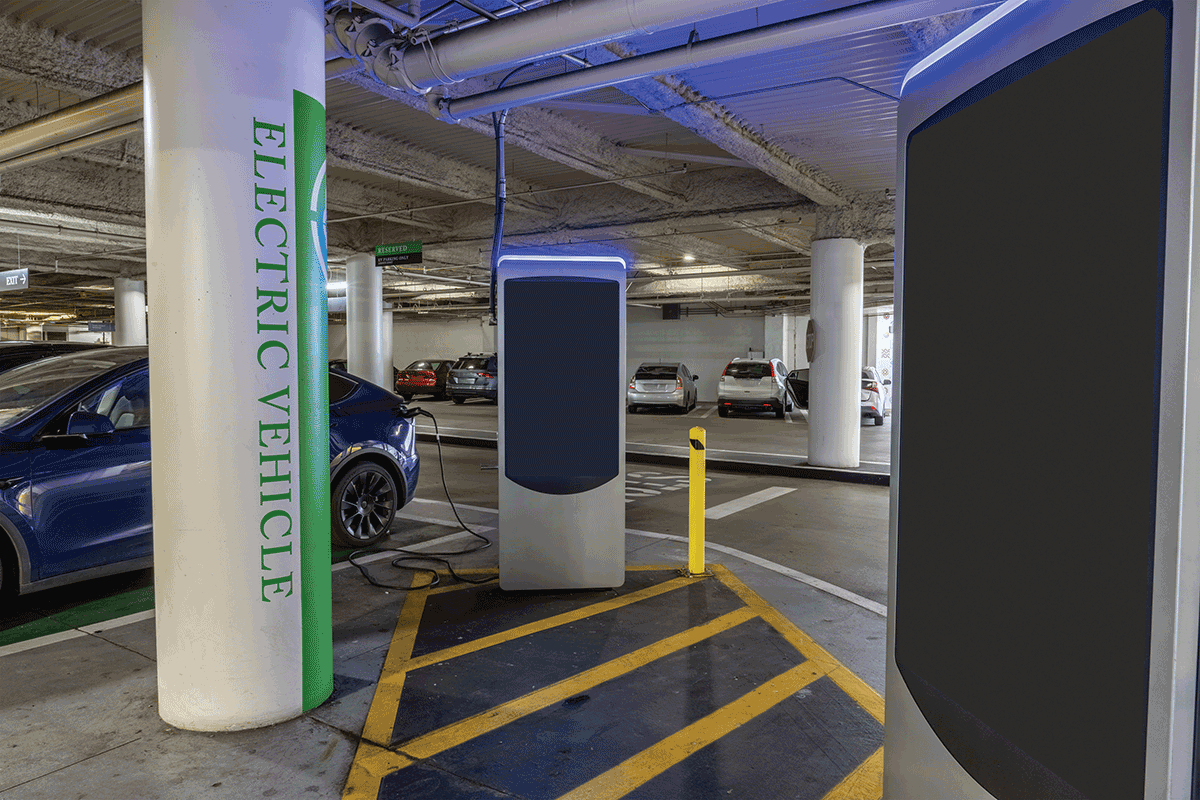

Electric vehicle charging infrastructure has entered a new phase—defined by higher power levels, increased complexity, and heightened expectations for reliability. As EV Infrastructure 2.0 expands from residential garages to commercial parking structures, fleet depots, and DC fast charging hubs, the role of the electrical inspector has never been more critical. The 2026 National Electrical Code (NEC) continues to refine Article 625 to address these evolving challenges, emphasizing items such as qualified installation, enhanced ground fault protection, proper disconnecting means, and clear equipment identification. For inspectors, understanding how these NEC requirements translate into real-world installations is essential to ensuring both the safety of users, as well as long term system reliability. The rest of this article will highlight some of the key changes associated with EVs within the 2026 NEC, providing insights to inspectors on areas they should look to evaluate when performing inspections on electric vehicle power transfer systems.
Addition of Article 624
Before further evaluating the changes that were made to Article 625 in the 2026 NEC, it is important to know that there has been a clear distinction made in the NEC around types of EVs based on the establishment of new Article 624. While the scope of Article 625 addresses electrical conductors and equipment connecting electric vehicles (EVs) to premises wiring for the purposes of charging, power export, or bidirectional current flow, new Article 624 covers the same scope parameters for electric self-propelled vehicles (ESVs). Additionally, both EVs and ESVs are now clearly defined in Article 100 of the NEC:
- Electric Vehicle (EV). An automotive-type vehicle for on-road use, such as passenger automobiles, buses, trucks, vans, neighborhood electric vehicles, and electric motorcycles, primarily powered by an electric motor that draws current from a rechargeable storage battery, fuel cell, photovoltaic array, or other source of electric current. Plug-in hybrid electric vehicles (PHEV) are electric vehicles having a second source of motive power. (CMP-12)
- Electric Self-Propelled Vehicle (ESV). A vehicle or marine vessel, other than an EV, such as farm equipment, boats, aircraft, and golf carts, primarily powered by an electric motor that draws current from a rechargeable storage battery, fuel cell, photovoltaic array, or other source of electric current. (624) (CMP-12)
The Informational Note accompanying the definition of an EV in the NEC provides further clarity by specifying examples of vehicles that are not classified as EVs. These include industrial trucks, hoists, lifts, transports, golf carts, airline ground support equipment, tractors, and boats. So, while inspectors will be tasked with inspecting power transfer system installations for both EVs and ESVs, it will be important to decipher up front whether the requirements being evaluated are from Article 624 or Article 625.
Qualified Persons
EV power transfer installations have increased tremendously over the past several years. Unfortunately, there have been a variety of individuals who performed those installations who have not necessarily been qualified to do so, making proper permitting and inspections all the more important in ensuring safe installations. New section 625.4 helps to make sure that installations are being done by qualified persons by providing enforceable language in the NEC.
Keep in mind, a qualified person is not simply a person that holds a license. The NEC definition requires demonstrated skills and knowledge related to the construction and operation of electrical equipment and installations, along with safety training to recognize and avoid hazards. By clearly requiring that electric vehicle power transfer system installations be performed by qualified persons, the addition of section 625.4 strengthens accountability and promotes NEC-compliant installations. Ultimately, this 2026 NEC update enhances safety and reliability for end users who simply expect their EV charging equipment to operate safely and dependably.
Field Marking
New section 625.5 establishes field marking requirements for electric vehicle supply equipment (EVSE) that must remain visible after installation. Code Making Panel 12 (CMP-12) provided a committee statement stating that the addition of field marking add a level of safety to both the field installer and anyone tasked with performing maintenance on this equipment. Providing safety to those that inspect this equipment is also a likely benefit. This new section requires the supply voltage, number of phases, frequency, and full-load current for each incoming supply circuit all to be marked on the equipment. It must also contain the short-circuit current rating of the EVSE, based on one of the following:
- Short-circuit current rating of a listed and labeled assembly, or
- Short-circuit current rating established utilizing an approved method
By requiring clearly visible field markings, section 625.5 ensures that critical electrical characteristics are immediately available to installers, inspectors, and maintenance personnel—reducing guesswork and the risk of misapplication or unnecessary exposure to potentially hazardous conditions. Ultimately, these marking will help support safer inspections, more informed maintenance decisions, and greater long-term reliability for EVSE installations.
Disconnecting Means
Understanding the critical nature of having proper disconnecting means in place for EVSE, as well as wireless power transfer equipment (WPTE) used for EVs, CMP-12 made several revisions to section 625.43 for the 2026 edition of the NEC. At first glance, it is clear that this section went from a single paragraph in the 2023 NEC to being broken down into four sections:
625.43(A) General
The general requirement states that all EVSE and WPTE must be equipped with a disconnect, which must be installed in compliance with Sections 625.43(B) through 625.43(D), as applicable.
625.43(B) Multifamily Dwellings
For multifamily dwelling applications, EVSE and WPTE with individual disconnecting means must include a plaque or directory mounted on the equipment. This plaque or directory must clearly indicate which disconnecting means serves the specific piece of equipment.
625.43(C) Equipment Disconnects
EVSE and WPTE that are permanently connected must have a readily accessible disconnecting means. If the disconnecting means is installed away from the equipment, a plaque or directory must be placed on the equipment to indicate its location. For cord-and-plug-connected EVSE and WPTE rated at 60 amperes or less or 150 volts to ground or less, the cord and plug may serve as the disconnecting means. All disconnecting means must be lockable in the open position, as required by Section 110.25.
625.43(D) Emergency Shutoff
For buildings other than one- and two-family dwellings, permanently connected electric vehicle supply equipment (EVSE) and wireless power transfer equipment (WPTE) must have one or more clearly identified emergency disconnect devices or electrical disconnects. These devices must:
- Be installed in an accessible location, no closer than 20 feet and no farther than 100 feet from the equipment, and within sight of the equipment.
- Disconnect power to all EVSE and WPTE visible from the emergency shutoff.
- Be clearly labeled as “EVSE EMERGENCY DISCONNECT” and include the warning, “WARNING: ELECTRIC VEHICLE(S) WILL REMAIN ENERGIZED,” per Section 110.22(A).
- Be manual reset type.
- Disconnect all ungrounded conductors simultaneously from the power source.
Additionally, the disconnecting means required under Section 625.43(C) may serve as the emergency disconnect if it meets all the criteria in Section 625.43(D).
Inspection Continuity through NFPA LiNK®
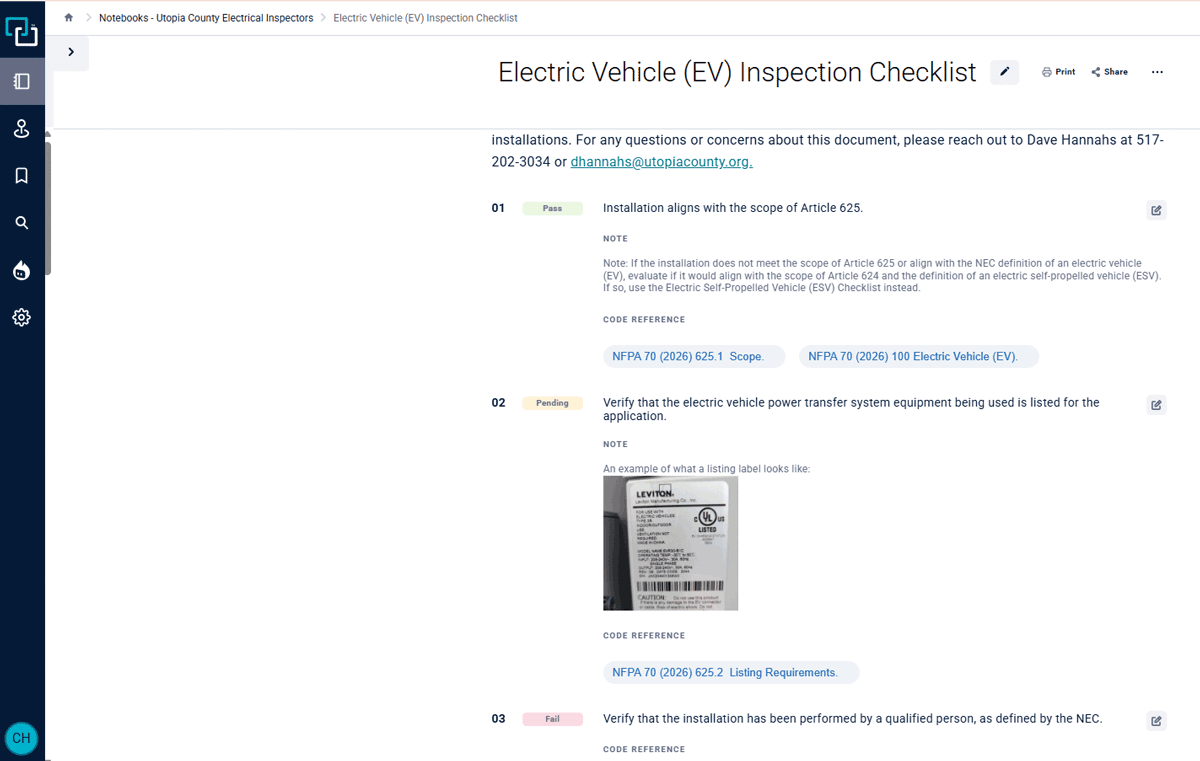
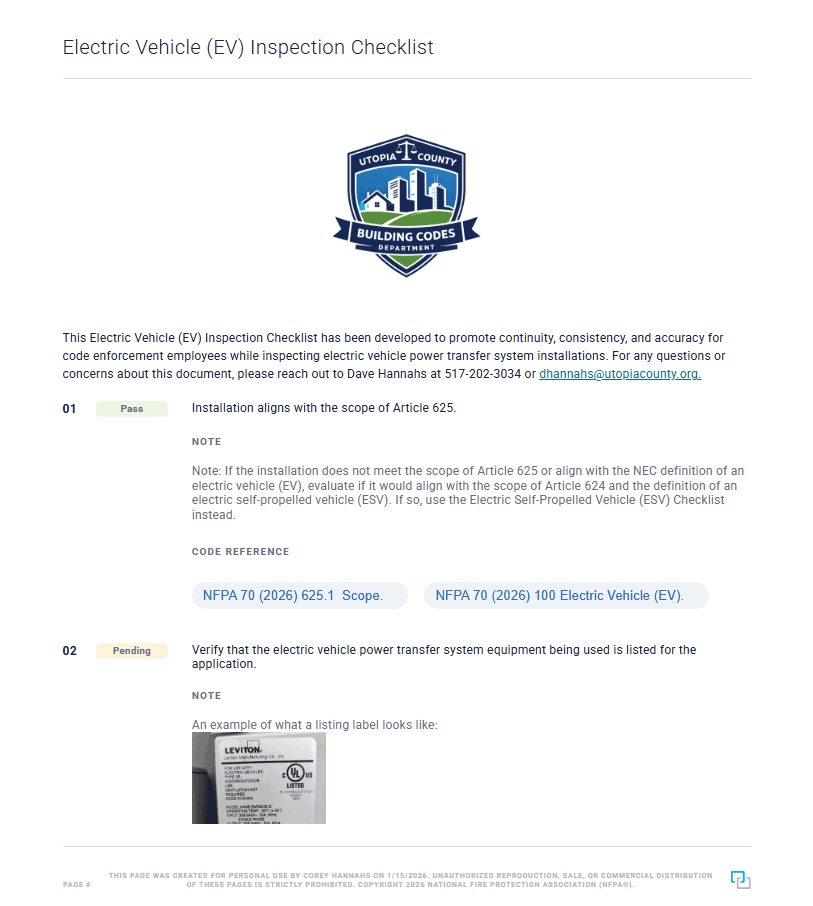
The recently added NFPA LiNK® Notebooks feature provides electrical inspectors with a helpful tool for streamlining inspections of electric vehicle power transfer systems and more. By allowing users to create customized checklists directly aligned with the edition of the National Electrical Code (NEC) they are enforcing, inspectors can ensure compliance with critical NEC requirements, such as proper disconnecting means and emergency shutoff installations. This feature streamlines complex inspections by delivering organized, actionable guidance based on NEC requirements and other NFPA codes and standards. It allows for the creation of customized checklists, incorporating photos, notes, and local compliance-specific information, which can be added and shared across the entire team to ensure consistency and continuity in code enforcement. To learn more about NFPA LiNK and access a FREE 14-day trial, please visit www.nfpa.org/LiNK.
Conclusion
As the demand for electric vehicle charging infrastructure continues to grow, the 2026 NEC provides inspectors with vital tools to ensure installations are safe, reliable, and compliant. From the refined scope distinction between EVs and ESVs in Article 625 and Article 624 to the new requirements for qualified personnel, field markings, and disconnecting means, these updates underscore the importance of thorough inspections in protecting end-users and technicians alike, while maintaining system safety and reliability. Electrical inspectors play a pivotal role in translating these new requirements in the 2026 NEC into real-world safety. By staying up to date and enforcing these new NEC requirements, inspectors help address the challenges of this rapidly evolving infrastructure while fostering public safety and confidence in EV technologies.
Important Notice: Any opinion expressed in this column is the personal opinion of the author and does not necessarily represent the official position of NFPA or its Technical Committees. In addition, this piece is neither intended, nor should it be relied upon, to provide professional consultation or services.