
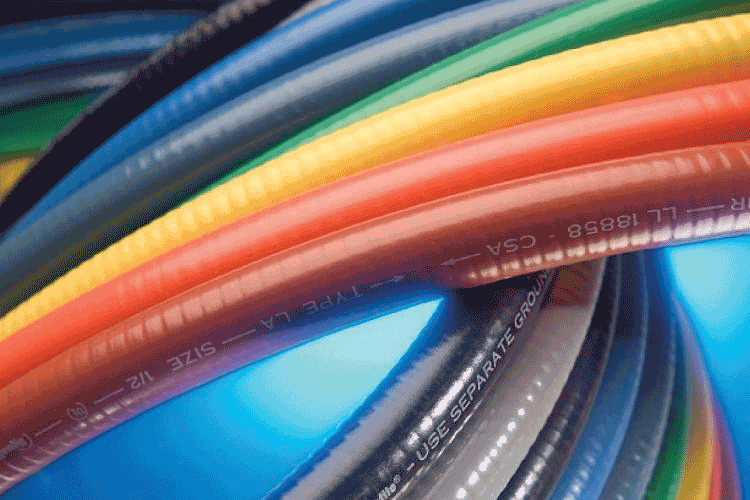

When electrical wiring is exposed to moisture, corrosive environments, vibration, or complex routing conditions, selecting an appropriate wiring method becomes critical. Liquidtight Flexible Metal Conduit (LFMC) is one wiring method recognized in NEC Article 350 for use in wet locations and applications requiring flexibility and mechanical protection.
LFMC offers versatility and strength by integrating a high-quality metal core with a polymer jacket. This design creates a strong pathway that protects the wire in indoor and outdoor settings. This includes installations with complex bends or where bending electrical metallic tubing (EMT) is not an option.
But many electrical conduit choices exist, and making the right selection depends on your application’s specific requirements and the manufacturer’s recommendations.
We discuss the advantages of Liquidtight flexible metal conduit and pinpoint its best applications below.
Simpler Installation
Many people often compare LFMC to rigid metal conduits like EMT. Each variety of conduits has its own strengths and ideal applications.
However, LFMC provides flexibility that can simplify installation in applications with complex routing or where field bending of rigid conduit would be impractical. Installation challenges are also minimal, though mating LFMC with LFMC connectors may require light instruction or training for first-time users.
The National Electrical Code (NEC) specifies requirements for several types of conduits, like LFMC, based on installation conditions. For instance, LFMC’s use in wet locations is detailed under Article 350 of the NEC, considering aspects like grounding needs, mechanical protection and corrosion resistance. The code also addresses sizing, bending and conductor capacity to ensure safety and compliance.
Easy Customization and Compliance
The protective polymer jacketing of LFMC ensures a Liquidtight raceway and safeguards electrical systems from moisture and corrosive substances.
LFMC products are available in various core materials and jacketing types to address differing environmental conditions, including corrosion resistance, temperature rating, and mechanical durability requirements. LFMC products can be personalized with different materials and coatings to suit various conditions they may face. Such customization could include flexible metal core variations, such as steel, stainless steel, aluminum, bronze, or nonmetallic varieties. Each material type presents different performance characteristics, including weight, corrosion resistance, and flexibility, which should be evaluated based on the installation environment.
Flexible jacketing varieties also offer various specialty benefits, such as oil-resistant, halogen-free/low smoke, extreme temperature protection, antimicrobial, colored options to identify circuitry, or unjacketed metallic that does not contain a jacketing material over the metal core.
Liquidtight flexible conduit and connectors come in many sizes to fit all electrical installations.
LFMC products and connectors also comply with electrical codes and other regulatory standards, including UL360 and CSA 22.2 No56-17. These standards specify the construction, materials, sizing, and performance tests LFMC must pass for registration and approval by a Nationally Recognized Testing Laboratory (NRTL). Most LFMC products are made to fit standard LFMC connectors, even if they don’t all get fully listed.
Moreover, a complete Liquidtight system, consisting of LFMC and compatible Liquidtight connectors, is engineered to connect securely, reaching IP ratings up to IP68 and IP69 as per IEC 60529 standards.
Cost-Effective and Durable
LFMC often costs more than rigid conduits, but they save more money and maintenance in the long run by eliminating the costly, labor-intensive work rigid conduits require, such as cutting, threading and bending.
When and Where to Use LFMC
LFMC solutions are often used in industrial and commercial applications like motors and pumps because they are strong and can withstand vibration damage. Specialty LFMC can also be used in mass transit applications to help make safe connections for rail transit in tunnels and in highways for expansion joints.
The application of LFMC is particularly recommended in several scenarios:
- Wet and Moist Environments: Liquidtight conduit is best for wet environments where cables need to handle humidity, dampness, or wetness. Typical applications include rail & transit, healthcare, wastewater treatment plants, utilities and food and beverage processing facilities—all areas where water is used in production or cleanup. Using Liquidtight conduit improves safety, extends cable lifespan and reduces electrical failures when used correctly.
- Corrosive Environments: LFMC excels against corrosive agents that could otherwise damage wires and cables. This feature is particularly advantageous for use in HVAC systems, manufacturing, chemical and energy refineries, steel mills, pharmaceuticals and other locations susceptible to corrosion.
- Dusty and Dirty Settings: Unprotected wires and connections exposed to dirt, dust and small particles can result in short circuits and malfunctioning equipment. But a sealed, Liquidtight conduit offers adequate protection against the intrusion of dust and particulates in these environments, including data centers, and construction.
- Outdoor and Exposed Areas: Electrical installations exposed to outdoor environments—like renewable energy applications, rail & transit, datacomm, and telecommunications—have an increased risk of potential issues. Damage and breakage can result from UV rays and temperature fluctuations, and various other external factors. However, sunlight-resistant flexible conduit can safeguard cables and wires against sun damage, extreme temperatures, and moisture. In applications subject to intense UV, ensure the polymer jacket is formulated to withstand these conditions and prevent deterioration.
Summary
LFMC provides a flexible, corrosion-resistant wiring method suited for installations where moisture, vibration, or complex routing are present. Its construction allows it to perform effectively in a range of industrial, commercial, and outdoor environments when installed in accordance with applicable code requirements. As with any wiring method, installers and inspectors should evaluate environmental conditions, grounding continuity, support requirements, and fitting compatibility to ensure compliance and long-term reliability.
