
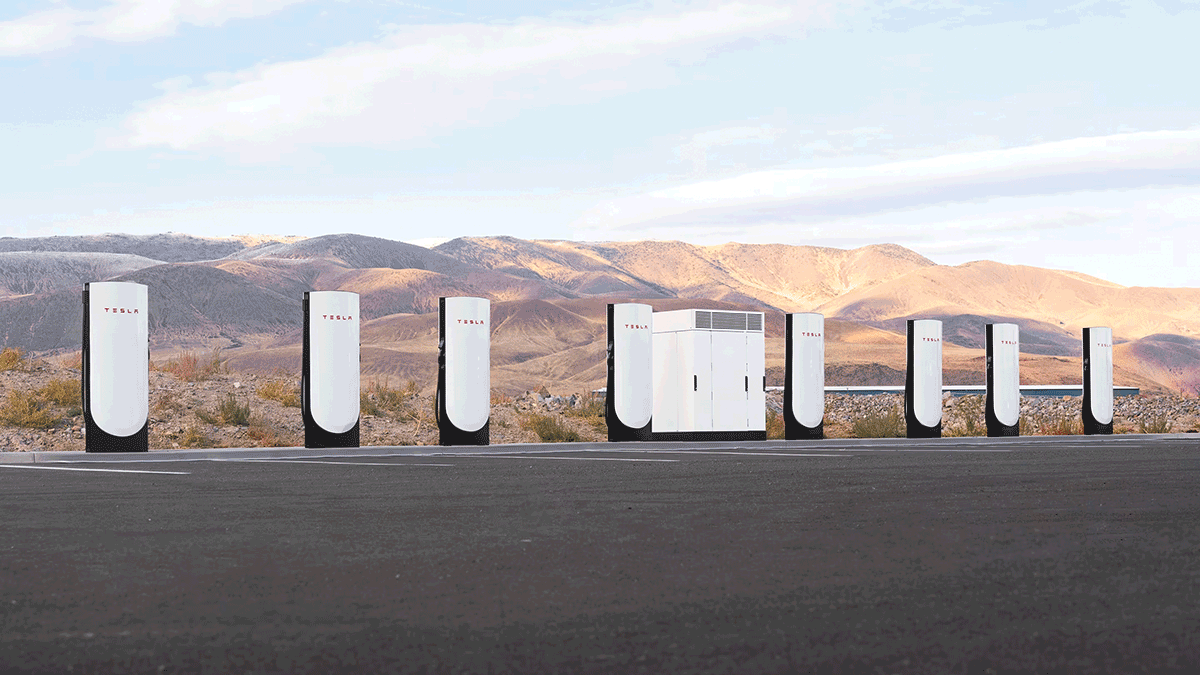

Fast charging for passenger EVs currently ranges from 150 to 350 kW. The industry is now pushing beyond that. In 2025, BYD introduced a 1,000-V platform and flash-charging battery system enabling peak charging near 1 MW for passenger vehicles, supported by plans for large-scale deployment with energy storage to manage grid constraints [1, 2]. In the heavy-duty sector, the Megawatt Charging System (MCS) targets 3,000 A at up to 1,250 V DC, or 3.75 MW, and has undergone multi-vendor evaluation under CharIN and U.S. national laboratory leadership, demonstrating early success including Ethernet-based ISO 15118-20 communication at 1,000 A [3,4].
by Omri Tayyara, Business Manager of Energy Power & Energy Storage at CSA Group
Tesla’s Megacharger network for electric freight vehicles has already deployed ~1.2 MW chargers on select U.S. freight corridors, signaling industry readiness to scale [5].
However, this emerging phase of EV infrastructure is not defined by maximum power.
Megawatt-class hardware will matter less than megawatt-class reliability.
A high-power charger that cannot start a session consistently is not delivering utility, regardless of its rating.
Reliability Has Become the Defining KPI
Reported uptime often fails to reflect the actual driver experience. Studies comparing measured availability with user outcomes show that first-time charge success is the more meaningful reliability metric. Field data from operators and service organizations such as ‘ChargerHelp!’ suggest that 25–33% of sessions may fail, especially at aging sites or where communication interoperability is weak [6]. Although J.D. Power reports gradual improvement, public charging reliability remains a leading barrier to EV adoption.
Reliability depends increasingly on:
- Interoperable communications between EV, EVSE, and network
- Thermal stability of high-current connectors
- Detectable, diagnosable failure modes
- Mean-time-to-repair (MTTR) measured in hours, not weeks
- Data visibility into coolant flow, cable temperature, and contact resistance
In short, megawatt-class charging requires fleet-grade maintainability, not just powerful equipment.
Communications: The Software Backbone of Charging Networks
Two complementary communication layers are central to dependable, scalable charging:
- OCPP 2.0.1 (Open Charge Point Protocol), now IEC 63584
OCPP coordinates network-level control: firmware, monitoring, diagnostics, tariffing, and power sharing. Version 2.0.1 adds security profiles, certificate management, standardized device models, and clearer fault traceability, all critical to uptime [7,8]. OCPP 2.0.1 has been formalized and adopted as an International Electrotechnical Commission (IEC) standard, published under the designation IEC 63584. - ISO 15118-20 (Vehicle-to-Charger Communication)
ISO 15118 governs the secure handshake at the EV inlet, enabling Plug & Chargeauthentication and defining bidirectional energy functions forV2G. For MCS-class charging, CharIN recommends Ethernet-based physical layers (e.g., 10BASE-T1S) to maintain signal integrity under high electromagnetic load, an approach validated in OEM supplier testing [9].
These two standards are not interchangeable.
OCPP governs the charger fleet.
ISO 15118 governs the vehicle-level handshake.
Networks that align both layers achieve higher charge success rates and faster commissioning.
Safety, Certification, and Installation Codes
In North America, DC fast charging equipment up to 1,500 V DC is typically evaluated under:
| Standard | Scope |
| UL 2202 | DC EV fast charging equipment |
| UL 2594 | General EVSE construction |
| UL 2231-1/-2 | Personnel protection |
| UL 2251 | Connectors and couplers |
| CSA C22.2 No. 107.1 | Power conversion equipment (Canada) |
For installations:
NFPA 70 (NEC) 2023 Article 625 establishes EVSE circuiting, load control, fault protection, and now explicitly addresses bidirectional operation [10].
Canadian Electrical Code (CEC) C22.1:24 Section 86 governs EV charging systems, with provincial adoption schedules, such as Alberta’s April 1, 2025, implementation, and local amendments issued by AHJs [11].
As sites add energy storage or grid export:
- IEEE 1547-2018 / 1547.1-2020define interconnection performance and certification test methods.
- UL 1741remains the primary certification path for Distributed Energy Resources DER interconnection.
- IEEE 2030.1.1-2021provides technical requirements for DC quick and bidirectional chargers.
- The near-term V2G pathway is expected to be DC-coupled, where the grid-interactive inverter is stationary within the EVSE, simplifying approval and interconnection.
Practical Design Guidance for Operators and AHJs
- Engineer for Reliability and Maintainability
Require OCPP 2.0.1 support, standardized device models, remote diagnostics, and field-replaceable coolant, connector, and controller assemblies. - Treat Megawatt Charging Sites as Hybrid Power Systems
Integrating battery energy storageimproves grid compatibility, reduces demand charges, and improves site stability, already part of 1 MW passenger charging strategies announced by several OEMs [1, 2]. - Design for Thermal and Human Factors
Liquid-cooled cables are required at high current. Heavy-duty depots should consider robotic or assisted cable handling to reduce ergonomic risks. - Prioritize Interoperability from Day One
Select equipment tested in CharIN and NREL interoperability showcases, with ISO 15118-ready stacks, and proven certificate provisioning workflows.
Outlook
By 2030, megawatt-class charging will likely be standard across freight corridors and present at select passenger hubs. Early deployments in the U.S., Europe, and China show that success depends on the convergence of power electronics, communications reliability, and code compliance.
Operators who align their systems to the standards and practices summarized above will deliver:
- Higher first-time charge success
- Lower operational downtime
- Better user experience
- Safer charging at kiloampere currents
Megawatt-class charging is less a leap in power than a maturation of EV infrastructure into utility-grade critical equipment.
CSA Group
CSA Group plays an integral role in supporting the safety, reliability, and performance of electric vehicle (EV) infrastructure across North America. Our expertise spans the entire EV ecosystem, from residential and commercial charging equipment to megawatt-scale charging systems, distributed energy resources, and integrated energy storage solutions.
- Extensive Testing & Certification for EVSE and High-Power Charging
We certify EV charging equipment to the full suite of North American standards, including UL/CSA 2594, UL 1741/CSA C22.2 No. 107.1, ANSI/UL 2202, and evolving requirements for high-power DC fast charging. Our evaluation process covers electrical safety, construction review, interoperability, thermal performance, environmental durability, cybersecurity considerations, and functional safety elements where applicable. - Power Conversion and Grid Interconnection Expertise
For advanced charging systems that incorporate power conversion stages or grid interactive functionality, CSA Group provides certification and custom testing aligned to UL 1741 SB, IEEE 1547, NEC/CEC requirements, and utility grid interconnection rules. This enables manufacturers to deploy charging systems that integrate seamlessly with utility infrastructure, support bidirectional power flow, and help meet future-ready grid performance expectations. - Energy Storage Integration & Safety Support
As EV charging increasingly pairs with stationary energy storage, we support manufacturers in navigating through UL 9540, UL 9540A, UL 1973, and CSA C22.2 standards for batteries, ESS, and hybrid systems. Our capabilities include full fire propagation testing, fault injection, thermal runaway analysis, and system-level interoperability between ESS, PCS, and EVSE architectures. - Large-Scale Fire Testing and R&D Support
CSA Group conducts custom research and large-scale fire testing for battery modules, packs, and integrated EV charging systems. These evaluations help manufacturers verify safety strategies, enclosure designs, emergency response features, and code compliance for both indoor and outdoor installations. Clients rely on this early-stage data to help de-risk engineering decisions and streamline certification timelines. - Field Evaluation, Limited Production Certification & Installation Compliance
For pre-certified systems, site-specific deployments, or pilot installations, CSA Group provides Field Evaluation (FE) and Field Certification (FC). This supports Authorities Having Jurisdiction (AHJs) by validating installations comply with applicable sections of the NEC/CEC, local amendments, and safety expectations for emerging EVSE technologies. - End-to-End Support for Clients at Any Stage
Whether a client is refining early prototypes or scaling global deployment, CSA Group can support each stage of the product lifecycle. This includes design reviews, technical information services (TIS), documentation guidance, custom testing, and coordinated certification across international markets through the IECEE CB Scheme. Together, these services provide a structured, standards-based approach that helps clients navigate technical requirements and regulatory expectations as products move from development to market access.
Learn More about EVSE Testing & Certification
Scan the QR code to learn more about CSA Group’s testing, inspection, and certification services for electric vehicle supply equipment (EVSE), including support across applicable standards and market requirements. csagroup.org/evse
References:
https://www.techbrew.com/stories/2024/08/12/chargerhelp-analysis-ev-charging-stations
https://mobilityportal.eu/charin-key-points-mcs-paper/
Impact of Electric Vehicle Charging Station Reliability, Resilience, and Location on Electric Vehicle Adoption
https://openchargealliance.org/protocols/ocpp-protocols/ocpp-2-0-1/
https://monta.com/en/blog/upgrade-to-ocpp-2-0-1/
https://www.chargerhelp.com/post/news-and-events/chargerhelp-report-reveals-charge-success-rate-and-not-uptime-more-accurate-metric-for-ev-driver-experience/
https://assets.website-files.com/612e28aaabd9b394c14ef12c/615f59e20c559e2e9c2cee8b_IEEE-1547-2018-SPI-Draft-rev-i-20180924-Final-Additions.pdf
https://standards.ieee.org/ieee/2030.1.1/7171/
https://www.engineerlive.com/content/megawatt-charging-soon-be-reality-heavy-duty-electric-vehicles
https://www.nfpa.org/news-blogs-and-articles/blogs/2024/05/13/importance-of-using-the-latest-nec-for-ev-charger-installations
https://www.csagroup.org/store/product/2431261ol/?srsltid=AfmBOoqLHM5WcBG2BID3SEuTnd3CgGidjYId1ltHmxFeMuT-B2RhyFXF